Valid Interpretations
The concept of a valid interpretation is the foundation of Boltzmann entropy. Understanding it unlocks everything else about transaction privacy.
What Is a Valid Interpretation?
A valid interpretation is a complete story about which inputs funded which outputs in a transaction.
More precisely, it is a partition of all inputs and all outputs into groups, where each group's input sum equals its output sum (within the transaction fee tolerance).
Let us unpack that definition step by step.
The Building Blocks
Inputs and Outputs
Every Bitcoin transaction has:
- Inputs: The UTXOs being spent (where the money comes from)
- Outputs: The new UTXOs being created (where the money goes)
Consider this 2-input, 2-output transaction:
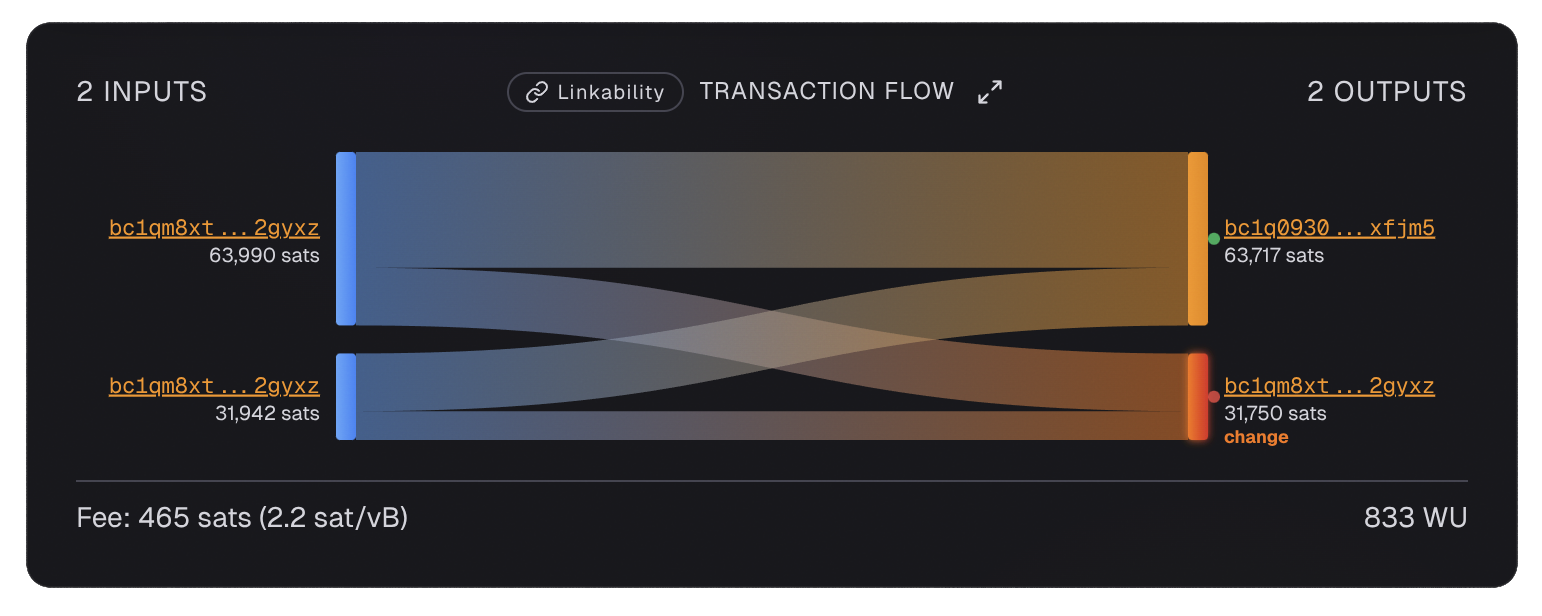
Transaction ID: ce3d95a2...
Total inputs: 95,932 sats Total outputs: 95,467 sats Difference (fee): 465 sats ✓
The Key Constraint
For an interpretation to be valid, every group of inputs and outputs must satisfy a simple rule: the total value of inputs in the group minus the total value of outputs in the group must equal some portion of the transaction fee (and cannot be negative - you cannot create bitcoin).
In other words, each group must "balance" within the fee tolerance.
One-to-One vs. Many-to-Many Mappings
The Intuitive (But Incomplete) View
Most people naturally think of transactions as one-to-one mappings:
- Input 1 funded Output 1
- Input 2 funded Output 2
This is how we think about handing over specific banknotes: I give you a $20 note for a $20 item. That note funded that item.
But in Bitcoin, the reality is more flexible. A single input can fund multiple outputs, and multiple inputs can combine to fund a single output.
The Many-to-Many Reality
A valid interpretation is a many-to-many mapping. Consider the 2-input, 2-output transaction above:
Interpretation 1: - Input 1 (63,990) funds Output 1 (63,717), leaving 273 sats for fees - Input 2 (31,942) funds Output 2 (31,750), leaving 192 sats for fees
Total fees: 273 + 192 = 465 ✓
Interpretation 2: - Input 1 + Input 2 (95,932 combined) fund both Output 1 + Output 2 (95,467), leaving 465 sats for fees
Total fees: 465 ✓
This transaction has 2 valid interpretations, so its intrinsic entropy is:
A More Complex Example
Consider a transaction with the following structure:
Input 1:  10,000,000 sats
Input 2:   1,380,000 sats

Output 1:    100,000 sats
Output 2:  9,850,000 sats
Output 3:    100,000 sats
Output 4:  1,270,000 sats

Fee: 60,000 sats
Total inputs: 11,380,000 sats Total outputs: 11,320,000 sats Difference (fee): 60,000 sats ✓
Let us find all valid interpretations.
Interpretation 1:
- Input 1 (10M) funds Output 1 (100k) + Output 2 (9.85M) = 9.95M, leaving 50k for fees
- Input 2 (1.38M) funds Output 3 (100k) + Output 4 (1.27M) = 1.37M, leaving 10k for fees
Total fees: 50k + 10k = 60k ✓
Interpretation 2:
- Input 1 (10M) funds Output 2 (9.85M) + Output 3 (100k) = 9.95M, leaving 50k for fees
- Input 2 (1.38M) funds Output 1 (100k) + Output 4 (1.27M) = 1.37M, leaving 10k for fees
Total fees: 50k + 10k = 60k ✓
Interpretation 3:
- Input 1 + Input 2 (11.38M combined) fund ALL outputs (11.32M), leaving 60k for fees
Total fees: 60k ✓
This transaction has 3 valid interpretations, so its entropy is:
This is the same structure as the original DarkWallet CoinJoin that LaurentMT used in his 2015 paper.
Why Many-to-Many Matters
This is the critical insight that many explanations miss: a single input can fund multiple outputs in the same interpretation.
In Interpretation 1 above, Input 1 funds both Output 1 AND Output 2. This is not two separate transactions - it is one interpretation of how the single transaction's funds flowed.
This is why the number of valid interpretations can be much larger than you might expect. For a 5-party CoinJoin, you might naively think there are 5! = 120 interpretations (one for each permutation of which input maps to which output). But the actual number is 1,496 - more than 12 times larger - because many-to-many mappings are also valid.
Deterministic Links
Even when there are multiple valid interpretations, some input-output links may exist in all of them. These are called deterministic links.
Intrinsic vs. Actual Entropy
Looking at the 2-input, 2-output transaction above in isolation (its intrinsic entropy), there are no deterministic links - no single input-output pair appears in all interpretations:
| Link | Interpretation 1 | Interpretation 2 | In Both? |
|---|---|---|---|
| I1 → O1 | Yes | No | No |
| I1 → O2 | No | Yes | No |
| I2 → O1 | No | Yes | No |
| I2 → O2 | Yes | No | No |
However, when we look at the actual entropy (incorporating blockchain context), the picture changes. In this specific transaction, am-i.exposed uncovered 2 deterministic links because the same address appears in both an input and an output.
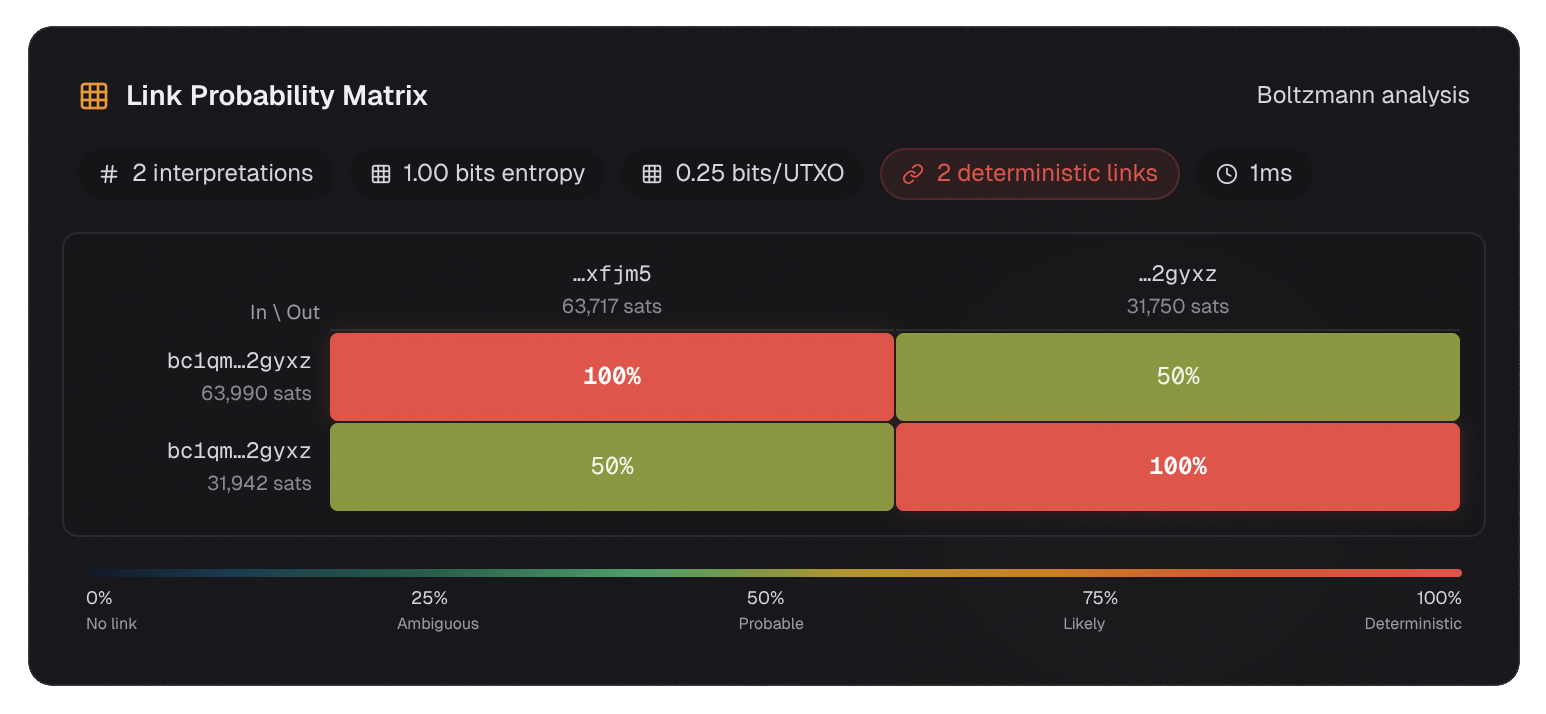
When an address that funded the transaction also receives an output, that output is certainly change. This reveals which other outputs are payments and the exact payment amount. This is an example of actual entropy being lower than intrinsic entropy - the blockchain context reduced the number of valid interpretations.
This is the essence of the CoinJoin Sudoku attack described by Kristov Atlas: even in a CoinJoin transaction, some participants may have deterministic links, meaning the CoinJoin provides zero privacy for them specifically.
Key Takeaways
- A valid interpretation is a partition of all inputs and outputs into groups where each group balances
- Many-to-many mappings are real - one input can fund multiple outputs in the same interpretation
- This is why N can be much larger than n! - the partition model counts many-to-many, the permutation model only counts one-to-one
- Deterministic links exist in ALL interpretations - they are privacy leaks even in CoinJoins
- Actual entropy can be lower than intrinsic entropy - blockchain context (like address reuse) reduces ambiguity
What Comes Next
Now that you understand valid interpretations, the next page explains the Link Probability Matrix - how to read it, what it tells you, and what deterministic links mean for your privacy.