Stonewall
Let us look at a Stonewall transaction - a technique that creates a transaction indistinguishable from a 2-party CoinJoin, but performed by a single user.
This example demonstrates the Boltzmann entropy framework. A Stonewall creates modest entropy (2 bits, 4 interpretations) - far less than a CoinJoin but far more than a normal payment (0 bits). For the full explanation of how entropy works, see the What Is Entropy? page.
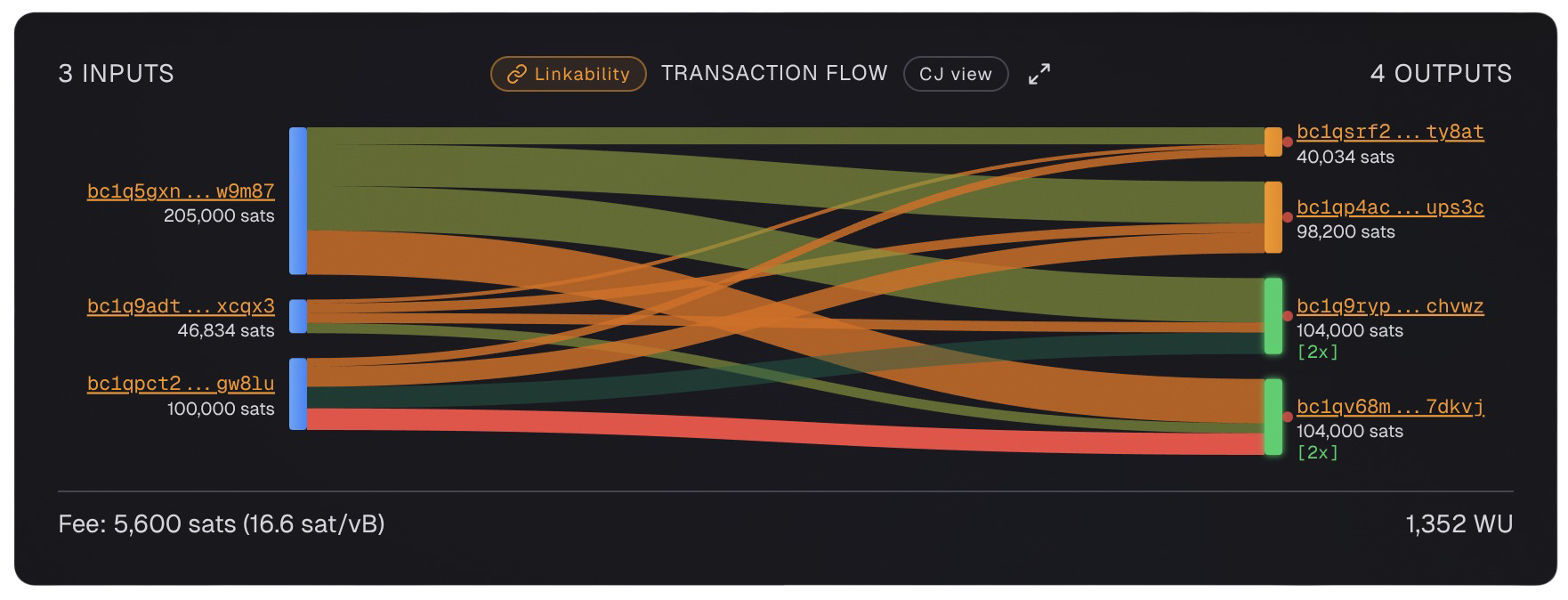
Transaction ID: 19a79be39c05a0956c7d1f9f28ee6f1091096247b0906b6a8536dd7f400f2358
Structure: 3 inputs → 4 outputs (2 equal outputs of 104,000 sats + 2 other outputs)
What We Notice
This transaction has 3 inputs and 4 outputs, with 2 outputs being exactly equal (104,000 sats each). Let us look at the Boltzmann entropy analysis:
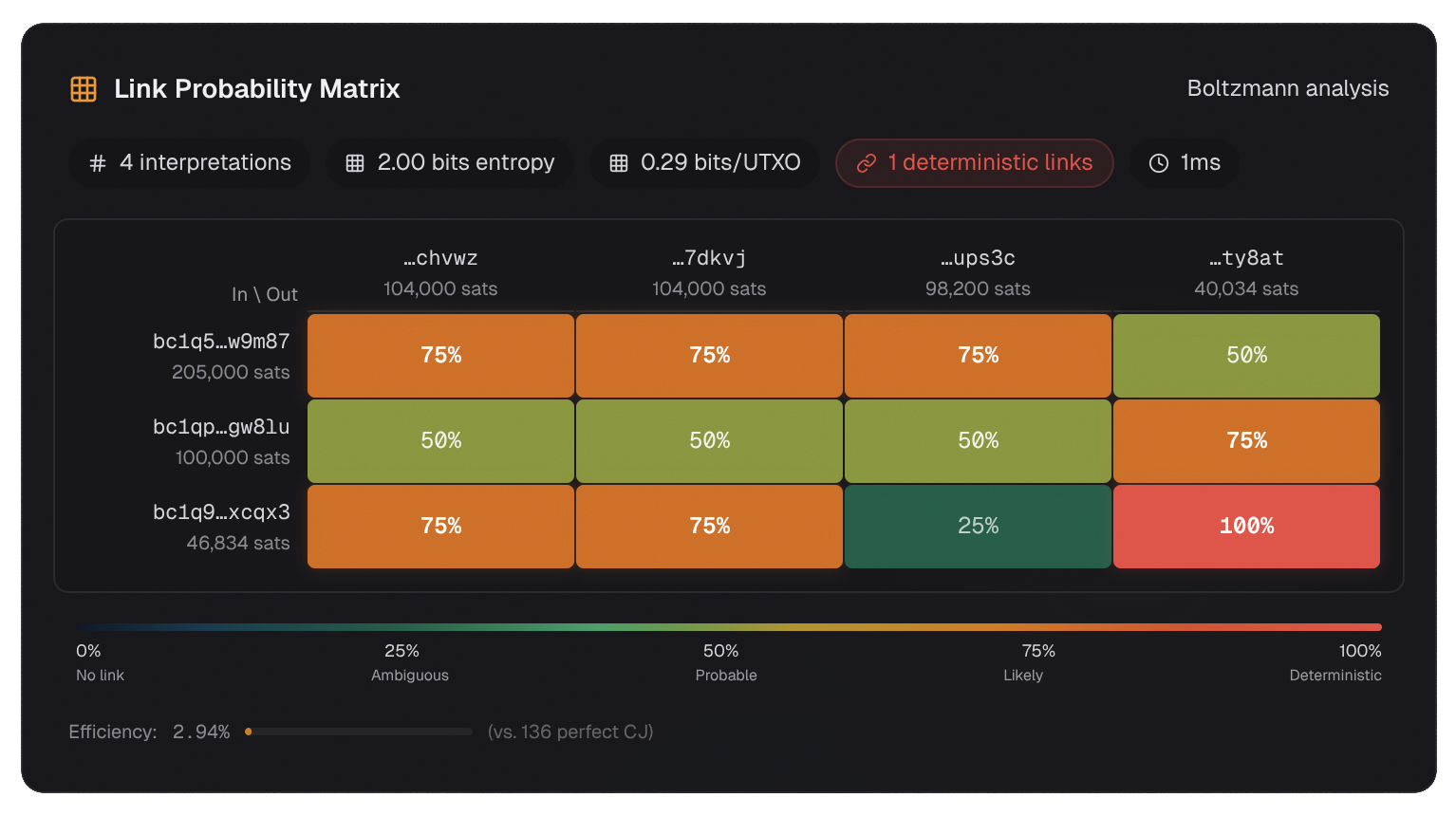
Key Findings
- 4 valid interpretations (2.00 bits of entropy)
- 0.29 bits per UTXO
- 1 deterministic link
The Link Probability Matrix Explained
The matrix above shows the probability that each input funded each output. Unlike the Whirlpool CoinJoin which had 1,496 interpretations, this Stonewall has only 4.
Why Only 4 Interpretations?
A Stonewall transaction has a specific structure: - 3 inputs in this case (from the sender's wallet) - 4 outputs: 2 equal-value outputs (104,000 sats) + 2 different-value outputs (change)
The 4 valid interpretations represent the different ways the 3 inputs could have funded the 4 outputs while respecting the value constraints. Each interpretation is a valid "story" about how the funds flowed.
2 Bits of Entropy
Entropy = log2(4) = 2.00 bits. This is modest compared to Whirlpool's 10.55 bits, but it is far better than a normal payment's 0 bits.
1 Deterministic Link
One input-output pair has a 100% link this is because the 46,834 sats input could only create an output smaller than itself (40,034 sats in this specific example).
Why Stonewall Creates Ambiguity
am-i.exposed detected this as a Stonewall pattern. Here is what that means:
Stonewall is designed to create ambiguity about input ownership - an observer cannot tell if all 3 inputs belong to one wallet (solo Stonewall) or two wallets (STONEWALLx2, a collaborative version).
This is the key privacy benefit: plausible deniability. Even if an analyst suspects this is a Stonewall, they cannot prove whether it was solo or collaborative.
The Critical Rule
Never spend two outputs from this transaction together. If you do, you confirm common ownership and destroy the ambiguity the Stonewall created.
Stonewall vs Normal Transaction
| Feature | Normal 3-in-4-out | Stonewall |
|---|---|---|
| Equal outputs | Unlikely | 2 equal outputs by design |
| Entropy | Usually 0 bits | 2+ bits |
| CIOH broken | No | Yes (appears collaborative) |
| Plausible deniability | None | Solo vs collaborative unknown |
Lesson
Stonewall adds meaningful entropy to a transaction and confuses chain analysis heuristics. From the outside, it can be misinterpreted as a small two-party CoinJoin. The ambiguity about who paid and who contributed which inputs/outputs is the privacy benefit.
Best practices: - Do not overuse Stonewall - if every transaction has this structure, it becomes a wallet fingerprint - Never spend two outputs from a Stonewall together - Combine with good address hygiene and coin control